The argument began in the spring of 2025, before drones had fully become the organizing grammar of the war in Ukraine.
The first version was the April 2025 essay Toward True Agility in Swedish Defense Procurement. It argued that FMV and the broader Swedish defense-procurement ecosystem remained shaped by Waterfall and V-model assumptions at precisely the moment when modern defense capability was becoming digital, iterative, software-defined, and difficult to specify correctly in advance.
The second version was the May 2025 podcast and full transcript "Mission Command vs Swedish Defense Procurement Process". That text sharpened the argument by placing Swedish procurement logic against Swedish military doctrine. On one side stood uppdragstaktik -- Mission Command -- built on intent, initiative, trust, tempo, and adaptation. On the other side stood an acquisition system built around requirements, contracts, traceability, procedural caution, and delayed certainty.
The claim was never that FMV is slow in the ordinary bureaucratic sense. That claim would have been too easy. The deeper point was that Sweden’s doctrine and Sweden’s capability-delivery machinery were operating from different theories of action.
Mission Command assumes that the world changes faster than central plans can absorb. It gives subordinates intent and expects judgment.
Traditional procurement assumes that enough certainty can be produced upfront to specify, contract, deliver, verify, and accept capability through controlled stages.
These are not merely different methods. They are different views of reality.
One treats uncertainty as the environment in which capability must act. The other treats uncertainty as a risk to be reduced before capability can be delivered.
One year later, that contradiction has not disappeared. It has become easier to see.
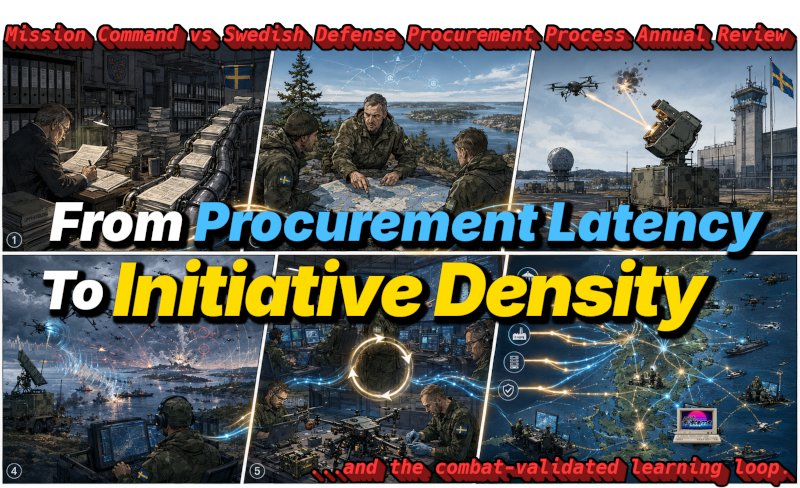
The original argument
The April 2025 essay made the practical reform argument first.
It argued that true agility in Swedish defense procurement would require legal, organizational, cultural, and technical reform at the same time. Procurement law and its interpretation would need to allow capability-driven, modular, outcome-oriented contracts rather than fixed-scope specification contracts. FMV would need to move from a control-tower model toward long-lived, cross-functional product teams that include FMV personnel, suppliers, and actual end users from the Armed Forces. The culture would need to protect experimentation, blameless learning, and fast user feedback. The technical foundation would need secure DevSecOps platforms, shared development environments, telemetry, automated testing, modular architectures, and continuous delivery.
The essay also warned against the common theatre of modernization: installing modern tooling inside an unreformed operating model. DevOps tools do not create agility by themselves. They are products of an agile worldview. When they are grafted onto a Waterfall bureaucracy, they usually produce frustration rather than speed. The phrase in the essay was deliberately blunt: putting DevOps tooling into a Waterfall organization is like putting a jet engine on a wagon. The part is modern; the vehicle is not.
The May 2025 text then made the doctrinal argument.
It compared Swedish Mission Command with the V-model and traditional defense acquisition. Mission Command is intent-driven. The V-model is specification-driven. Mission Command decentralizes judgment. Traditional acquisition centralizes control. Mission Command expects adaptation. Traditional acquisition treats change as a cost, a deviation, or a contractual problem.
It also compared that acquisition logic with my Outcome-Based Agile Framework. OBAF begins with outcomes, not requirements. It treats constraints as boundaries, not preselected solutions. It treats plans as hypotheses, evidence as the arbiter, and teams as owners of problems rather than executors of task lists.
In hindsight, the April and May texts belong together. The April essay said that Sweden needed different legal, organizational, cultural, and technical machinery. The May text said that this was not merely a delivery preference. It was required by the logic of Mission Command itself.
A military can write doctrine around initiative and still equip itself through processes that punish initiative. It can speak in terms of mission effects and still contract for outputs. It can praise adaptability in the field while starving the capability pipeline of feedback, experimentation, and local authority.
That was the core claim.
The issue was never paperwork as such. The issue was the relationship between intent and delivery.
The coordination shift in defense
The annual review needs a second frame: the thesis from 10x: The Coordination Shift -- Software Engineering in the Centaur Era.
The coordination shift is simple to state. When AI and automation make execution cheaper, faster, and more abundant, the bottleneck moves.
In software, the bottleneck moves away from typing, scaffolding, drafting, and implementation. Those activities still matter, yet they become less scarce. The scarce resources become intent, judgment, architecture, verification, coherence, integration, ownership, and coordination between units.
Execution gets cheap. Coordination becomes visible.
The same pattern is now visible in defense.
If procurement can be accelerated, procurement is no longer the only bottleneck. Once buying gets faster, the constraint moves downstream and sideways: doctrine, training, operator skill, data pipelines, logistics, repair, electronic-warfare adaptation, software updates, stockpiles, experimentation rights, unit-level feedback, manufacturing scale, and decision latency.
This is why the 2026 review cannot stop at the fact that Sweden has announced faster purchases. Faster purchases matter. They are necessary. They are not the same thing as a faster capability loop.
The defense version of the coordination shift is this:
When capability production gets faster, the bottleneck moves to coordination, verification, absorption, and learning.
This is also why Ukraine has become the reference case.
Ukraine is not the reference because it entered the war with the most modern force. It did not. Ukraine is not the reference because it has the most exquisite platforms. It does not. Ukraine is the reference because it has turned war into a live capability-learning system.
What changed since May 2025
The April 2025 essay argued that agile procurement was no longer an aspirational ideal but a strategic necessity. One year later, that sentence reads less like a recommendation than an understatement.
By May 2026, the drone war had moved from important to structurally dominant.
Ukraine and Russia now expend drones at a scale that would have sounded implausible in many European defense discussions only a few years ago. FPV drones, Shahed-type systems, reconnaissance drones, naval drones, fibre-optic drones, interceptor drones, electronic-warfare payloads, and improvised integrations are no longer experimental edges. They are part of the operating fabric of the war.
The exact battlefield percentages should be handled carefully. Official claims, commander estimates, and open-source analyses do not always measure the same thing. The direction, however, is not ambiguous. Drones now shape sensing, striking, attrition, interdiction, force protection, logistics pressure, and the cost-exchange logic of the battlefield.
More importantly, Ukraine has built mechanisms around them.
Brave1 Market lets Ukrainian units use combat-earned e-Points to order drones and related systems. Ukraine’s Ministry of Defence reported that units had ordered 240,000 drones and other systems through the market in six months, with average delivery time around ten days and hundreds of Ukrainian-made products available.
That is not merely procurement. It is a feedback system.
The unit creates battlefield effects. The state allocates purchasing power. Technology flows back to the front. Manufacturers observe demand and performance. The loop tightens.
The data layer matters just as much.
Ukraine launched Brave1 Dataroom, a secure environment for testing and training military AI systems using real battlefield data. Reporting in 2026 also described Ukraine opening battlefield data access to allies and defense companies for AI model development, with large quantities of annotated material from real combat missions.
This changes the nature of defense innovation.
The battlefield is no longer only consuming capability. It is training the next generation of capability.
That should unsettle every traditional acquisition organization. The decisive advantage is not merely who has the best drone today. It is who has the fastest combat-validated learning loop.
Sweden has moved, mostly at the purchasing layer
The annual review has to be fair. Sweden has not ignored the lesson.
In October 2025, the Swedish government announced more than SEK 5 billion for increased anti-drone and Gripen capabilities, explicitly stating that anti-drone lead times would be shortened by eight years, from a previous final delivery target of 2036 to 2028. In January 2026, the government announced more than SEK 5.3 billion for drone and space capabilities, including loitering munitions, reconnaissance drones, unmanned airborne electronic-warfare capabilities, and unmanned maritime systems. In April 2026, Sweden announced a large air-defense and anti-drone package intended to broaden protection beyond military units toward population centres and critical infrastructure.
These are real changes.
They also prove the point.
The system can move when political pressure, budgetary permission, and operational evidence become strong enough. Sweden can shorten timelines. Sweden can place large orders. Sweden can use existing industrial capacity. Sweden can recombine known components into useful systems.
LOKE is the most interesting example.
The LOKE counter-drone concept, developed by FMV, the Swedish Air Force, and Saab, was deployed in a NATO mission in Poland and became part of Swedish base-defense capability. Saab later received an FMV order for a mobile, modular C-UAS (Counter-Unmanned Aircraft Systems) system worth approximately SEK 2.6 billion, with deliveries in 2027-2028. Saab describes the system as built from established components, integrating sensors, effectors, and selected third-party technologies into an interoperable solution.
That is useful work. It is also not enough.
LOKE is valuable as local protection. It is a serious effort within Swedish constraints. It demonstrates that the Swedish system can compose available products into a new operational package under pressure.
Its limits are equally important.
The current war does not only ask whether a system can defeat one drone, five drones, or a serial attack. It asks whether a defense system can survive mass, variation, cheapness, operator adaptation, EW counter-adaptation, and cost-exchange pressure over time.
A counter-drone system that can protect a base against limited attacks may be excellent inside its intended envelope. A national defense posture cannot confuse that with the ability to withstand the scale, density, and adaptation rate visible in Ukraine.
Sweden has accelerated selected procurements. It has not yet demonstrated a national capability loop comparable to what the war has forced Ukraine to build.
Initiative density
The strongest concept for the 2026 review is initiative density.
Initiative density is the number and variety of purposeful, coordinated initiatives a system can generate per unit of time.
It is not speed alone. It is not innovation theatre. It is not the number of pilots, projects, startups, or procurement decisions.
Initiative density is the practical ability to run many meaningful moves at once: experiments, deployments, tests, adaptations, deception measures, training changes, production shifts, software updates, procurement adjustments, EW responses, and doctrinal refinements.
A system with high initiative density does not wait for one perfect programme. It creates many bounded initiatives, observes which ones survive contact with reality, and scales the ones that work.
A system with low initiative density may still spend a lot of money. It may announce large packages and buy advanced systems. It may even accelerate selected procurements. It still cannot generate enough simultaneous adaptation to keep pace with a changing opponent.
John Boyd’s OODA loop is useful here, although the level of analysis has changed.
The problem is not only whether an individual commander can observe, orient, decide, and act faster than the opponent. The problem is whether the whole capability system can do so.
Can the state observe battlefield change? Can it orient across doctrine, industry, procurement, training, and intelligence? Can it decide without waiting for the old planning cycle? Can it act through production, deployment, software, EW, and operator training before the adversary’s next adaptation arrives?
When the answer is no, doctrine is trapped inside the unit while the system around the unit remains slow.
That is the Swedish contradiction in its 2026 form.
Mission Command cannot remain a battlefield doctrine only. It has to become a capability-development doctrine.
Centralized flows, decentralized effect
Major Olof Glans made a useful distinction in "Om uppdragstaktik och byråkrati", published by Militär Debatt in April 2026. His argument is not primarily about procurement. It is about the internal military tension between Mission Command, bureaucracy, risk minimization, and organizational design.
The important contribution is the balance he draws between centralization and freedom of action.
War requires local judgment because war is nonlinear, unstable, and resistant to prediction. Centralized linear control overloads when reality diverges from the plan. Mission Command therefore depends on people who can interpret context, exercise judgment, and act when opportunity appears.
At the same time, not every part of a military organization should be decentralized. Logistics, personnel administration, procurement, law, finance, security, and resource allocation require stable structures. Certain flows need standardization, predictability, and control. A military force cannot exercise local freedom of action unless it is equipped, supplied, paid, governed, and supported by systems that work.
Glans captures the principle in a useful formulation: centralized flows, decentralized effect.
That formulation should be read as a design rule for initiative density.
Initiative density does not mean organizational looseness. It requires disciplined centralization in the right places. Logistics channels, procurement mechanisms, compliance evidence, secure development platforms, data governance, interoperability standards, model-evaluation environments, and repair/replenishment flows must be stable enough to create freedom of action.
The error is not centralization as such. The error is centralization that migrates from enabling flows into operational effect.
A defense organization should centralize the machinery that increases trust, throughput, safety, and interoperability. It should decentralize the decisions that create local effect under changing conditions.
This distinction strengthens the annual review. The argument is not "less bureaucracy everywhere." The argument is better organizational design: centralized flows where stability creates freedom, decentralized effect where judgment creates tempo.
Glans also adds a necessary human layer: practical wisdom. Mission Command requires officers and operators who develop judgment by making real decisions under constraints. If every meaningful decision is escalated, reviewed, delayed, or standardized away, the organization does not merely lose tempo. It prevents the development of the very judgment that Mission Command requires.
This matters for procurement as well. Capability systems cannot learn if all practical judgment is displaced into documents, approval chains, and retrospective justifications. A learning system needs people and teams with authority to act, observe, correct, and own the result.
Combat-validated learning loops
The second concept is combat-validated learning loop.
A combat-validated learning loop is a system where operational use creates evidence, evidence changes decisions, decisions change production and deployment, and the next version returns to the field fast enough to matter.
This is stronger than user feedback. It is stronger than lessons learned.
Most organizations have lessons-learned processes. Many are graveyards for insight. The lesson is written down, filed, summarized, briefed, and slowly metabolized into nothing.
A combat-validated learning loop is different because it has a pathway from observation to changed capability.
In Ukraine, this pathway is increasingly visible. Units use systems. The battlefield produces video, telemetry, mission results, failure modes, and operator reports. Procurement mechanisms allocate purchasing power. Manufacturers see performance. AI systems are trained on real data. New systems are tested, bought, adapted, and returned to the front.
The loop is not clean. It is not free from waste, politics, duplication, error, or danger. Its decisive property is simpler: it is alive.
Traditional procurement can learn, but it often learns at the wrong cadence. It learns through studies, evaluation reports, requirement updates, budget cycles, and replacement programmes. That may work for slow-moving platform domains. It is much less suitable for drones, EW, AI-enabled targeting, software-defined capability, autonomy, and cheap mass.
In those domains, the learning loop is the capability.
Initiative-rich warfighting beyond Ukraine
Ukraine is the clearest reference because its learning loops are visible, urgent, and internationally demanded.
Other conflicts point in the same direction.
The wider wars and confrontations around Gaza, Lebanon, Iran, the Red Sea, and the Gulf have shown initiative-rich operations across intelligence, supply chains, cyber, drones, air defense, long-range strike, and psychological effect.
The Hezbollah pager attack was not an AI story in the transformer-era sense. Public reporting indicates a long-prepared supply-chain operation rather than a sudden generative-AI breakthrough. Its relevance lies elsewhere. It demonstrated that modern war reaches deep into procurement channels, device trust, logistics, communications habits, and organizational assumptions.
Operation Rising Lion, Israel’s June 2025 campaign against Iran, will be studied for years. Public analyses emphasize intelligence preparation, surprise, conventional airpower, pre-positioned or covertly enabled effects, and synchronized action across domains. The strategic consequences remain debated. The operational pattern is already clear enough: high initiative density can dislocate a larger adversary when intelligence, preparation, deception, fires, and decision tempo align.
The point is not to romanticize Israel, Ukraine, or any other actor. The point is to notice the common pattern.
The relevant organizations are not merely buying platforms. They are combining intelligence, software, drones, operators, supply-chain access, targeting, data, deception, and rapid adaptation into initiative-rich systems.
That is the new competitive field.
The new defense-industrial hierarchy
This also changes the defense market.
For decades, defense-industrial credibility was associated with platform maturity, engineering depth, certification, national trust, and prime-contractor scale. Those attributes still matter. Fighter aircraft, submarines, air-defense systems, sensors, missiles, naval systems, and command systems cannot be replaced by improvised drone workshops.
In drones, EW, autonomy, interceptors, and battlefield software, another form of credibility has become strategically valuable:
combat-validated learning speed.
This is why Ukraine is now being approached by countries that would previously have looked almost exclusively to established Western defense primes. Gulf countries facing Iranian drone and missile threats have reason to listen to the state that has spent years defending itself against Shahed-type attacks, mass drone waves, EW-contested environments, and cheap-strike economics.
That should be uncomfortable for Europe.
Ukraine began the full-scale war with a force still shaped by Soviet inheritance. It did not become a reference because it started with the best procurement model or the most modern defense-industrial base. It became a reference because survival forced it to build learning loops that many richer countries still lack.
That is the strategic embarrassment.
Europe is not short of engineers, defense companies, research institutions, money, or strategy documents. Europe is short of exploitation speed.
It can explore. It can analyse. It can regulate. It can produce papers. It can announce frameworks. It can fund programmes.
The decisive question is whether it can metabolize battlefield change into fielded capability before the next adaptation cycle arrives.
The Swedish problem, stated plainly
The Swedish problem is no longer simply procurement latency.
Procurement latency remains real. The 2025-2026 evidence nevertheless shows that selected procurements can be accelerated when the pressure is high enough.
The deeper problem is low initiative density around the capability once procurement has moved.
Glans’s distinction helps state the problem more precisely. Sweden does not need decentralization everywhere. It needs centralized flows that enable decentralized effect. The purchasing channel, compliance system, logistics backbone, secure development infrastructure, and data-governance layer should make initiative easier, not harder.
A system can buy more drones without producing enough drone operators.
It can buy counter-drone systems without building enough national saturation tolerance.
It can buy loitering munitions without integrating them into targeting, training, EW, logistics, airspace management, command authority, and replenishment.
It can buy AI tools without building classified inference infrastructure, secure data pipelines, model evaluation, red-team procedures, auditability, and operator trust.
It can buy systems without creating the learning loop that makes those systems improve.
It can also preserve formal Mission Command while denying the practical decision-making needed to develop Mission Command in people. Without real decisions, there is no mature judgment. Without mature judgment, there is no serious decentralized effect.
The 2026 review should therefore not claim that nothing happened. Something happened. Much of it happened at the easiest layer to describe politically: money, orders, acquisitions, and named systems.
The harder layer is the living system around the equipment.
That is where Mission Command either becomes real or remains doctrine.
What Sweden should measure now
The April 2025 essay proposed an Agile Procurement Lab or skunkworks as a realistic starting point: selected systems, empowered teams, short cycles, continuous demonstrations, open retrospectives, and direct collaboration between FMV, suppliers, end users, and regulators.
In 2026, that proposal should be made more operational and more severe.
Sweden should not only measure budget, orders, deliveries, and programme milestones. It should measure learning velocity.
How long does it take for an exercise observation, Ukrainian battlefield lesson, NATO mission finding, or operational failure mode to change a procurement decision?
How long does it take for a drone or EW failure mode to reach the manufacturer, the training unit, and the next software or hardware revision?
How many parallel experiments can the system run without collapsing into coordination overhead?
How many operators, maintainers, instructors, and tactical leaders are created per delivered system?
How quickly can countermeasures be tested against new drone types, frequencies, guidance methods, and attack patterns?
How fast can a classified AI capability move from dataset to evaluation to deployment under audit?
How many skunkworks-style capability teams have real authority to change course based on evidence?
How much compliance evidence is generated continuously by the delivery system rather than reconstructed after the fact?
These are not vanity metrics. They indicate whether the system is alive.
The old procurement question was: did we deliver what we ordered?
The new capability question is: did the system become more dangerous to the adversary because it learned?
OBAF, Centaur units, and Mission Command
OBAF is directly relevant to this problem because it is not a ceremony framework. It is not Scrum with different vocabulary. It is a framework for outcome ownership under uncertainty.
It begins with intent, constraints, signals, hypotheses, feedback loops, and after-action learning. That makes it much closer to Mission Command than traditional requirement-first procurement.
Mission Command says: here is the intent; act with judgment.
OBAF says: here is the outcome, the constraints, and the evidence loop; own the problem and adapt based on what reality tells you.
The Centaur Manifest adds the AI-era operating model. In AI-augmented work, a small human unit can explore, draft, build, test, and integrate at a speed that previously required larger teams. That only works when intent is explicit, constraints are enforced, verification is continuous, and learning is captured.
This maps directly onto drone-era and AI-era defense.
A modern drone unit is not soldiers plus equipment. It is a human-machine system: operators, maintainers, EW specialists, intelligence, targeting, repair, software, data, logistics, training, and feedback. The same applies to AI-enabled intelligence work, C-UAS operations, maritime drones, and software-defined command systems.
The scarce skill is not merely operating a device. The scarce skill is steering the whole human-machine capability loop.
The business implication
For industry, the opportunity is not to sell AI as decoration.
The opportunity is to build the operational substrate for constrained, high-trust, high-learning environments.
That means secure local inference where cloud use is not acceptable. It means audit trails, model governance, evaluation harnesses, red-team loops, synthetic data, workflow state, traceability, access control, and integration with real operational systems. It means the boring machinery that lets an organization learn faster without losing control.
The same pattern appears outside the battlefield in small manufacturing, critical infrastructure, public-sector operations, and defense-adjacent companies.
Execution is getting cheaper. Tools are getting faster. AI can produce drafts, code, plans, analyses, configurations, and options.
The bottleneck moves to coordination: which changes matter, what must not break, what evidence is trusted, who owns the outcome, how learning is captured, and how fast the organization can adapt without becoming incoherent.
That is the same thesis in another domain. The defense case is simply the most unforgiving version of it.
The annual review
The April and May 2025 texts got the main structural point right.
There was, and still is, a contradiction between Sweden’s doctrine of initiative and its traditional model of capability delivery.
The original argument focused on procurement latency, true agility, and doctrinal incoherence. The 2026 argument has to focus on initiative density and combat-validated learning loops.
Sweden has shown that it can accelerate selected purchases. That is good. It is also insufficient.
Ukraine has shown that the decisive advantage in drone-era warfare is not simply possessing drones, or even producing drones at scale. The decisive advantage is connecting units, evidence, procurement, production, data, AI, training, and battlefield feedback into a loop that learns faster than the adversary.
That is the coordination shift in defense.
When production gets faster, production stops being the only constraint.
When procurement accelerates, procurement stops being the only explanation.
The bottleneck moves to the system around the capability.
The next Swedish reform therefore cannot be another strategy document, another isolated pilot, or another accelerated purchase alone. It has to be a capability-learning architecture.
That is what the April 2025 essay was reaching for when it called for modular procurement, long-lived cross-functional teams, blameless learning, secure DevSecOps environments, and agile skunkworks. One year later, the language can be simpler and more severe.
Sweden does not only need agile procurement.
It needs a national defense capability loop that can survive contact with a faster-learning adversary.
-
Not outputs. Outcomes.
-
Not delivery as final acceptance. Delivery as the beginning of learning.
-
Not procurement as administration. Procurement as operational strategy in motion.
-
Not Mission Command only in the field. Mission Command in the capability pipeline.
The state that learns fastest wins the next version of the war before the slower state has finished buying the last one.
References and related material
Original May 2025 text and podcast transcript: Mission Command vs Swedish Defense Procurement Process
Michel Blomgren: Toward True Agility in Swedish Defense Procurement
Michel Blomgren: 10x: The Coordination Shift -- Software Engineering in the Centaur Era
Michel Blomgren: The Centaur Manifest
Michel Blomgren: The Outcome-Based Agile Framework
Swedish Government: More than SEK 5 billion for increased anti-drone capabilities and Gripen capabilities
Swedish Government: More than SEK 5.3 billion to enhance drone and space capabilities
Reuters: Sweden to buy air defence systems for 8.7 billion crowns
Olof Glans: Om uppdragstaktik och byråkrati
Saab: The "Loke" Counter-Drone Concept Debuts in NATO Mission
Saab: Saab receives order for counter-unmanned aerial system from Sweden
Ukraine Ministry of Defence: 240,000 drones ordered through Brave1 Market
Ukraine Ministry of Defence: Brave1 Dataroom secure environment for training military AI solutions
Defence News: Ukraine opens battlefield AI data to allies
Reuters: Zelenskiy pitches drone deal during Bahrain visit
AP: Zelenskyy visits Saudi Arabia as Ukraine provides expertise against Iranian drones
RUSI: Operation Rising Lion: The First 72 Hours
USNI Proceedings: Iran-Israel Conflict: A Quicklook Analysis of Operation Rising Lion
Reuters: Israel planted explosives in Hezbollah’s Taiwan-made pagers, sources say